

Boundary-Setting and Resetting
Have you ever found yourself replaying a conversation over and over and over after the fact? Wondering if you were too harsh? Or not clear enough? Maybe you said yes when you wanted to say no… but felt guilty about needing or asking for space? Maybe even just the idea of that fills you with dread. If this sounds familiar to you– you’re in good company. Many people go through similar internal loops, and even when it doesn’t seem like it, those loops do have exits. The challenge you experience in finding those exits however, could indicate that your internal boundary system could need a tuneup.
What do I mean by internal boundaries? Well, the external boundaries are more obvious– maintaining personal space, communicating sexual boundaries and consent, and speaking up when your limits have been crossed. But, there’s a whole world of internal boundaries that we don’t always talk about. The internal boundary system is what governs how we speak, how we listen to and receive what other people say, and the responsibility we feel for other people’s feelings. So many people today are exhausted from the emotional burnout that comes from people-pleasing, over-explaining, or over-personalizing the comments of others. These are examples of internal boundaries that are just a bit too flexible or permeable. The classic example of saying yes when you really want to say “no” is just the tip of the iceberg!
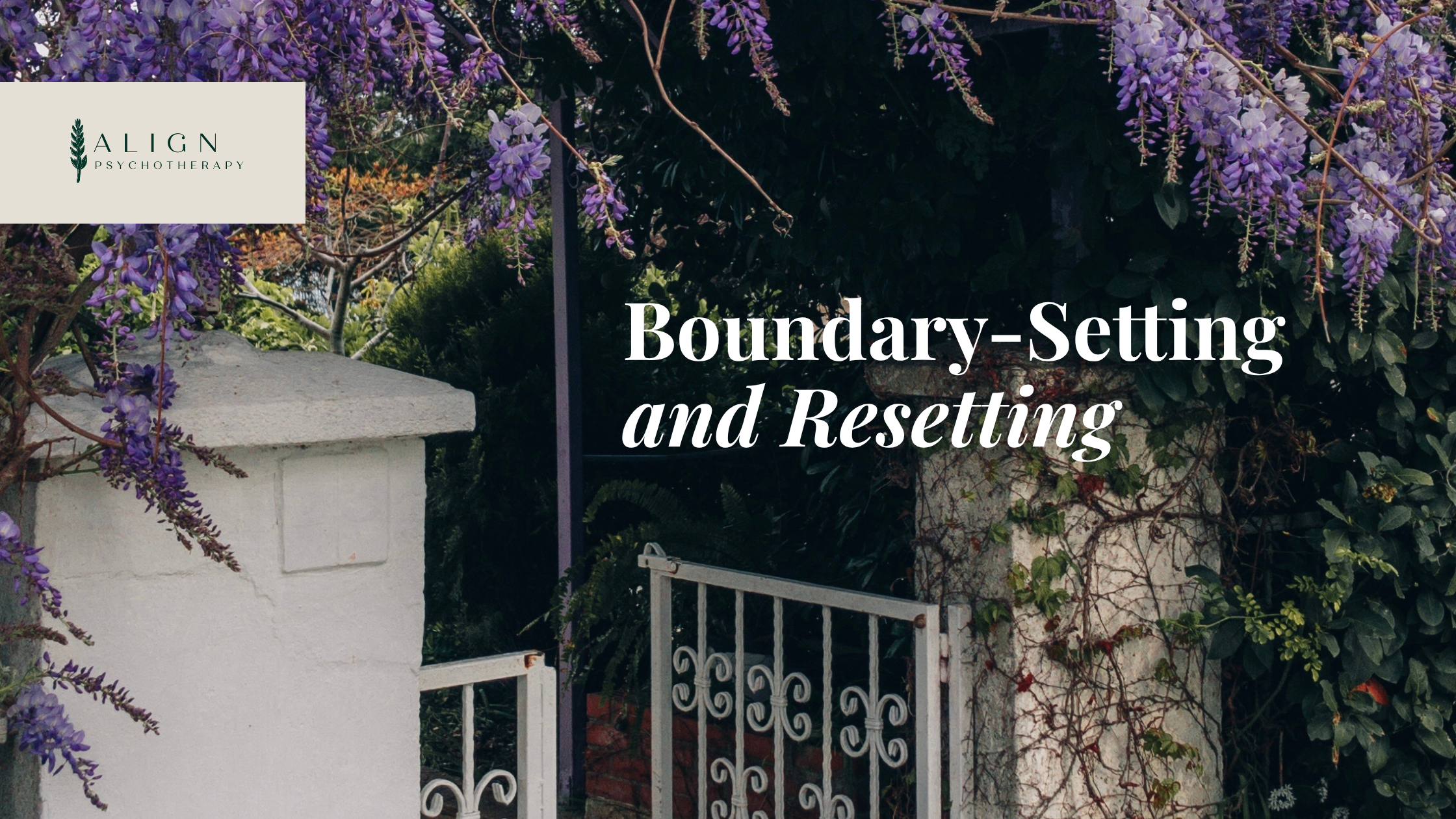
On the other hand, many folks overcompensate by moving to the other extreme, holding boundaries that are too rigid. This might look like cutting people off over small conflicts, never asking for help, or avoiding being seen in any state of vulnerability. If any of the above sounds familiar, don’t worry! There is a way forward, and that is the path of healthy boundary-setting. Not walls, but not open doorways either. A healthy boundary is more like a gate– they can open and close according to the person in control of it. And a self-aware gatetender is discerning! They rely on their own judgment to determine when to open wide, close tight, and when to remain cautiously ajar. This is the art of boundary-making.
Let’s use that classic example to illustrate what I mean by this. Let’s say someone you care about asks you for a favor when you’re already exhausted and juggling 5 tasks of your own…
Too flexible: “No problem, I’ll stop what I’m doing and help you right now.”
Too rigid: “I’m dealing with my own stuff, it’s selfish of you to ask when you know I’m busy.”
Flexible boundary: “I’d love to help, but today I think I’m at my limit. I can be available to help you tomorrow afternoon though.”
Notice – the healthy boundary does not require self-abandonment, but it also does not seek to punish the other person. It keeps respect for the humanity of both parties intact. This is the nuance that often falls through the cracks when we’re discussing boundary-setting.
As you might already be imagining, this style of boundary setting can be applied to many difficult conversations or to interactions with people who view the world differently than you. Differences in personality, values, culture, religion, politics, or life experience don’t automatically render a relationship unsafe, but they can certainly require more discernment. Some situations where these differences are present still allow for deep connection, because the relationship has enough space for mutual respect and curiosity. In others though, repeated disrespect or crossing of your limits might require a clearer physical boundary of walking away. But in lower-stakes circumstances with people you wish to remain connected to, boundaries serve the important function of protecting the relationship itself. They do this by protecting other people FROM US, while making us safer and more trustworthy people to love. Keeping your temper steady, not reacting in anger immediately, not trauma-dumping when someone is too depleted to hold it, speaking your mind instead of expecting your partner to read it, not absorbing and personalizing every word other people say … these are all examples of ways we can hold healthy internal boundaries for ourselves and others. They help us keep our side of the street safe too.
As you might already be thinking, this can be a very complicated balance to strike – say what you need because it’s not selfish? But also, know when to hold back? Sounds difficult for even the most evolved person. And, for many, it’s a lifelong journey. So if you feel like you struggle in this area, you are far from being alone. This is information that most people spend their later years trying to understand and apply. The thing is though, most people already know where these lines go because they feel guilt, shame, resentment, or depletion after the fact. These are cues signaling what could have been different to make the interaction healthier for both parties. Often people have a sense that they should have said no, asked for help, or avoided overextending themselves after the fact. So the harder question becomes: why does it feel so terrifying or impossible to do those things in the moment?
The answer to this question usually lies somewhere in the past. Maybe a person learned that love was conditional or given when convenient. Others carry the memory that expressing a need meant being abandoned, or that they had to yell to be heard. Whatever the case is for you, building a healthy system of boundaries is not as simple as learning new words– it means facing, naming, feeling, and healing the fears that lie underneath. This is where the help of a therapist can come in. Because tending the gate is not an easy task, especially not when old wounds and present-day emotion make it so difficult to see the path clearly. But, this process is learnable. With the support of another pair of eyes, you can learn to see not only the path and the gate, but to trust yourself as the person holding the keys as well.
A Simple Boundary Reset Ritual:
Pause.
Ask:
Am I closing this gate too tightly? Or leaving it wide open?
What do I need?
What does respect look like for both of us?
Act.
References
Mellody, P., Wells Miller, A., & Miller, J. K. (2003). Facing codependence: What it is, where it comes from, how it sabotages our lives. HarperCollins.
Tidwell Palmer, V. (2019). Moving beyond betrayal: The 5-step boundary solution for partners of sex addicts. Gentle Path Press.