

Nervous System Reset Ritual
With the changing pace and demands of life (in this economy no less!), many people find themselves operating in a state of constant urgency. You know those moments where everything feels important but it seems impossible to prioritize? Or those incidents when your patience is low, irritability is high, and you suddenly snap at loved ones over something small? Maybe your thoughts race while your body feels frozen, or you spend hours overthinking without actually taking action. All of these experiences can be signs of nervous system overload.
These moments can be deeply uncomfortable and frustrating for people, but they are not a reflection of laziness, lack of discipline, or some personal failure. More often, they indicate a deep underlying sense of overwhelm. When the nervous system shifts into survival mode, the body begins prioritizing protection over flexibility. Fight, flight, freeze, and even fawn responses are designed to help humans survive threatening situations, but when the nervous system becomes stuck in a prolonged state of activation, everything can begin to register as a potential threat. I’m sure you know the old adage – when you only have a hammer, everything starts to look like a nail. And from this place of depletion and overactivation, a person may notice themselves becoming reactive, more emotionally sensitive, or less able to tolerate everyday stressors.
Over time, many people become so accustomed to operating in this heightened state that they forget what genuine calm feels like. When this happens, even rest becomes difficult. Sleep may feel shallow. The body remains on high alert, scanning vigilantly for danger, even in relatively safe situations. This constant activation can impact not only emotional well-being, but physical health as well.
When the nervous system is overloaded, even small stressors can create outsized reactions. In the self-perception themed episode of the Mel Robbins podcast, Dr. Shadé Zahrai uses the metaphor of a ping pong ball versus a golf ball falling into water to represent the impact of our triggers on self-perception.When dropped into water, a ping pong ball creates a small ripple before the water settles again. Comparatively, a golf ball creates a much larger splash, upsetting the water, and creating a bigger mess. When the nervous system is regulated, everyday stressors are more likely to feel like the ping pong ball– manageable, temporary, and easier to recover from. But when a person is already stretched beyond their limits, even small inconveniences can feel like golf balls crashing into the water, creating emotional chaos that takes much longer to settle and may even create a bigger mess requiring later cleanup.
Naturally, the advice that overactivated folks receive is that they attempt to “relax,” but true nervous system restoration is not always the same thing as distraction. Zoning out in front of the television, endlessly scrolling on your phone, or mentally checking out may provide temporary escape, but these habits often keep the body disconnected and dysregulated – kind of like sleepwalking. Genuine restoration, on the other hand, tends to involve engaging the body and senses directly, in mindfully present ways. Warm showers, soft blankets, calming scents, grounding textures, nourishing food, stretching, meditating, or using gentle movement can all help to signal safety back to the stressed-out nervous system.
Let’s be clear though, regulation does not always require a perfect self-care routine or a quiet evening at home. Sometimes the nervous system simply needs small moments of interruption throughout the day to shift gears. To do this, the body often responds to physical cues more quickly than the mind responds to logic. In fact in times of intense stress, the logic-ing part of the brain may not even be online. In other words: sometimes you have to calm the body first so that the mind can follow.
Simple actions like humming softly, slowly rubbing the outsides of your arms, taking a brief walk, unclenching your jaw, or slowing your breathing can all help interrupt the stress cycle. Even changing environments for a few moments can help disrupt spiraling thoughts and create enough space for the nervous system to recalibrate. Disruption is key here– our brains get used to firing along the same neuronal pathways, and when we feel stuck, it’s likely that we ARE stuck and in need of an interruption. The more intentional awareness you can bring to these useful disruptions and scene changes, the better for the reset.
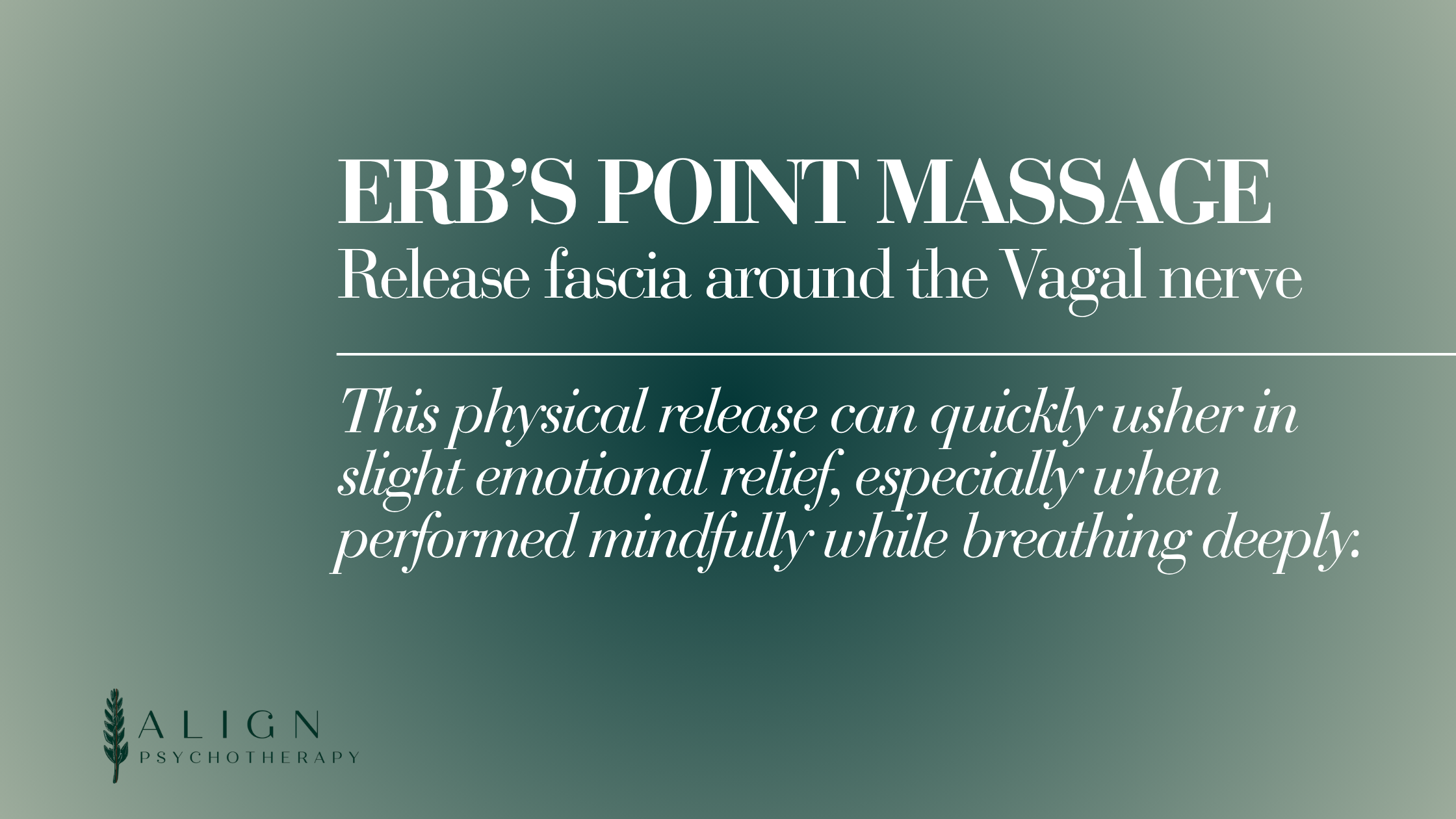
Some people also find relief through techniques like using the Erb’s point massage on the neck to release fascia around the Vagal nerve (instructional videos linked below). This physical release can quickly usher in slight emotional relief, especially when performed mindfully while breathing deeply. Another option for physical disruption might be activating the mammalian dive reflex– this one we do by splashing cold water on the face or briefly submerging the face in cold water for 30 seconds. Interestingly, the body naturally responds to water by slowing the heart rate and conserving energy, which is partially why swimming and water-based activities often feel so calming and regulating. Instructional videos can be found below for both of these techniques.
Mammalian Dive Reflex
The important thing to remember is this: nervous system regulation is not about becoming perfectly calm at all times. It is about increasing your ability to return to yourself after stress– this is the process of widening the window of distress tolerance. The goal is not perfection. The healing is in the return. And if you’re in a position where you are not able to access the body for reset, you can try a simple mental reset instead:
Pause.
Take one slow breath.
Look around, and name 3 things you can see.
Unclench your jaw, and relax your shoulders.
Now name 2 things you can hear.
Feel the support of your feet against the floor, or your body against the chair beneath you.
Ask yourself: What do I need right now?
Choose one small supportive action without overthinking it.
That’s it! Not fixing your whole life, not solving every problem immediately. Just interrupting the overwhelm long enough to reconnect with yourself again.
If you find that your nervous system has been operating in survival mode for a long time, therapy can help create a safe space to practice regulation, reflection, and reconnection. Sometimes healing begins simply by experiencing what it feels like to no longer carry everything alone. If you liked these rituals and techniques, Align is also launching a group that teaches skills like these and many more! Get in touch today to learn more.
_______________________________________
References
Burke Harris, N. (2018). The deepest well: Healing the long-term effects of childhood adversity. Houghton Mifflin Harcourt.
Robbins, M. (Host). (2025). The #1 mindset shift to stop negative thinking & build self-trust (No. 1000766679397 (tel:1000766679397)) [Audio podcast episode]. In The Mel Robbins Podcast. Apple Podcasts. https://podcasts.apple.com/us/podcast/the-mel-robbins-podcast/id1646101002?i=1000766679397
Sukie Baxter. (2021, August 10). Erb’s point and vagus nerve self massage [Video]. YouTube. https://www.youtube.com/watch?v=YH_CvXGsInc
Therapy in a Nutshell. (2022, June 14). The mammalian dive reflex for anxiety relief [Video]. YouTube. https://www.youtube.com/watch?v=Q3bir7XDcFc
van der Kolk, B. A. (2014). The body keeps the score: Brain, mind, and body in the healing of trauma. Viking.
York Cardiology. (2021, May 24). Mammalian dive reflex explained [Video]. YouTube. https://www.youtube.com/watch?v=_97x5R2odDI